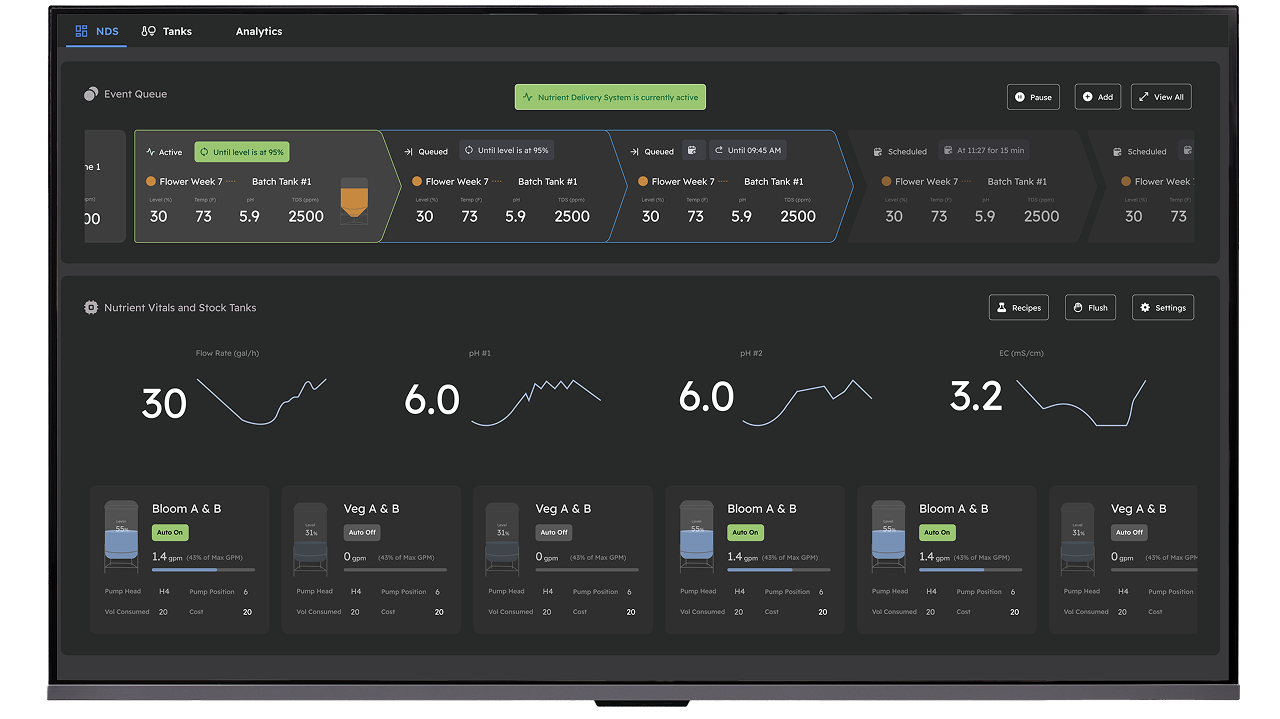
With the word "agentic" entering general media alongside AI, there's another layer of automation fatigue to deal with. The reaction is fair: the industry isn't short on buzzwords, and growers have earned their skepticism.
And yet we continue to call checking dashboards 5x or 3x a day "automation." That's because presentation follows data — it doesn't independently decide.
A smart sensor might show you a substrate that's drying too fast. It doesn't adjust the next irrigation. It can't determine enough.
A new class of system is doing that job now, and it bears naming: Agentic Cultivation™ — with proper context around what it means, what it replaces, and what changes when your grow starts making its own risk-based decisions to achieve the outcomes you set.

What is Agentic Cultivation™?
Agentic Cultivation™ is the use of AI agents that sense crop conditions, set and execute rules by orchestrating equipment — irrigation, fertigation, supplemental lighting, airflow, dehumidification, and CO2 enrichment — without manual intervention at every step.
The key word is agent. A true agentic system acts on a directed role — like an agent — to guide a grow facility to an outcome the operator defines. Not to replace the operator, but to remove decisions they don't need to make every cycle, every day.
It's crucial to frame it properly: agentic means the system reasons about context, controls equipment, and earns autonomy over time. It's a useful and precise term for growers — not marketing for control systems they're already buying.
Automated vs. agentic: what's actually different
A plain automated system performs mastered routines perfectly — if everything stays constant. It does the same thing at the same time every day. Agentic systems use the same sensors, the same valves, the same equipment. But the decision layer is fundamentally different.
Agentic is a paradigm for real-time execution. The system serves at the operational level — sense, decide, act — and that distinction matters.
| Automated | Agentic | |
|---|---|---|
| Who sets the logic | You write every rule. | You set the outcome. The system determines the adjustments. |
| Response to known conditions | Alarm sounds; system waits for human input. | Adapts: a setpoint corrects a drift and escalates when something needs to reach you. |
| Oversight required | Constant dashboard watching. | Review as needed: get notified when exceptions arise. |
| Improvement over time | Static: until someone reprograms it. | Every run refines the next: real adaptation. |
The loop: sense, decide, act, improve

If you've seen agentic described as if it's a single step: it's not. The system operates in a loop of the four stages above — built on the infrastructure you already have.
Sense: Substrate moisture, climate data, light levels, and equipment status — from sensors and controllers already in place.
Decide: Pattern matching and rule evaluation: given this state of the crop and the target outcome, what should happen next?
Act: The system executes — adjusting irrigation, climate setpoints, fertigation recipes, and lighting schedules through the equipment it controls.
Improve: Post-run analysis, recipe refinement, and model tuning. Every cycle informs the next one. The system doesn't just run — it gets better.
What agentic actually means for cultivators
This is how it works in practice.
Agentic handles the more consistent decisions that need to happen every hour — the VPD shift at 3 AM, a drying rate that's 0.5% behind today, the light recipe that changes by week (not month) to map a DLI ramp.
Your master grower gets scaled, not replaced.
They still set the plan for each cultivar. They still do what no automation can replace: visual inspection. Their judgement on the plants is the pattern before every other action in the pipeline. That expertise stays at the foundation of what the operation runs.
What changes is what their time is spent on.
Instead of manually adjusting 2x daily across a 4-sector facility — every single shot — when the same dryback percentage repeats for 3 days, a generative pattern emerges and the system corrects.
Instead of checking setpoints room-by-room every sunrise: a morning brief. The system gives them the three decisions left to make for the day. The rest is already handled.
Labor shifts from working inside the numbers to the team that actually runs the crop: siting, recipes, growing genetics, fighting pest outbreaks — the strategy, autonomy, and in time, the scale of what becomes natural.
The ROI of agentic control: Body Genetics
- Water and Nutrient Savings: Reduced irrigation waste by more than $8,000/month
- 40% Faster Prototype Runs: Crop recipe from R&D to 135 lbs
- Genetic Purity Increase: Premium 1st-round target at $14,152 up from $10,552
- Production Space Efficiency: 7% cost per square foot below 6-day direct

What agentic doesn't mean
Agentic control is not a general-purpose reasoning model running on a server at the facility. It's not a replacement for a cultivator — agentic systems without a strong team still fail at the actual work required every day to run a facility. It augments the expertise of the people in the grow rooms, not a novel replacement that breaks the process.
Agentic earns autonomy one room at a time, the same way you'd trust a new head grower.
Is your grow ready? Three questions to ask
- Can your platform close a loop? Getting sensors to relay info is table stakes. Does your system apply data as decisions and automate actions?
- Is your crop recipe deployed, or does the crop have a measured profile? Look at the purpose over time — a recipe is a starting point, not a fixed formula.
- Is your plant health, fertigation, and environmental control integrated? Settings, decisions, all of it needs to follow one process.
If you answered no to all of these, you're not behind — your path from automation to agentic is just starting.
Where this is heading (and Growlink's role)
The race isn't commoditization. It's precision at scale — and it will expand the agentic role in purpose-built, targeted systems and scalable facilities.
A unified platform — like Growlink's portfolio — can orchestrate equipment it controls and integrate equipment it doesn't. Blueprint for digital tools, and AI builds on top from there — every device, every sensor, every data point.
Get the playbook for agentic automation in your facility:
Get a Facility Consultation Request a Demo